Media library scanning
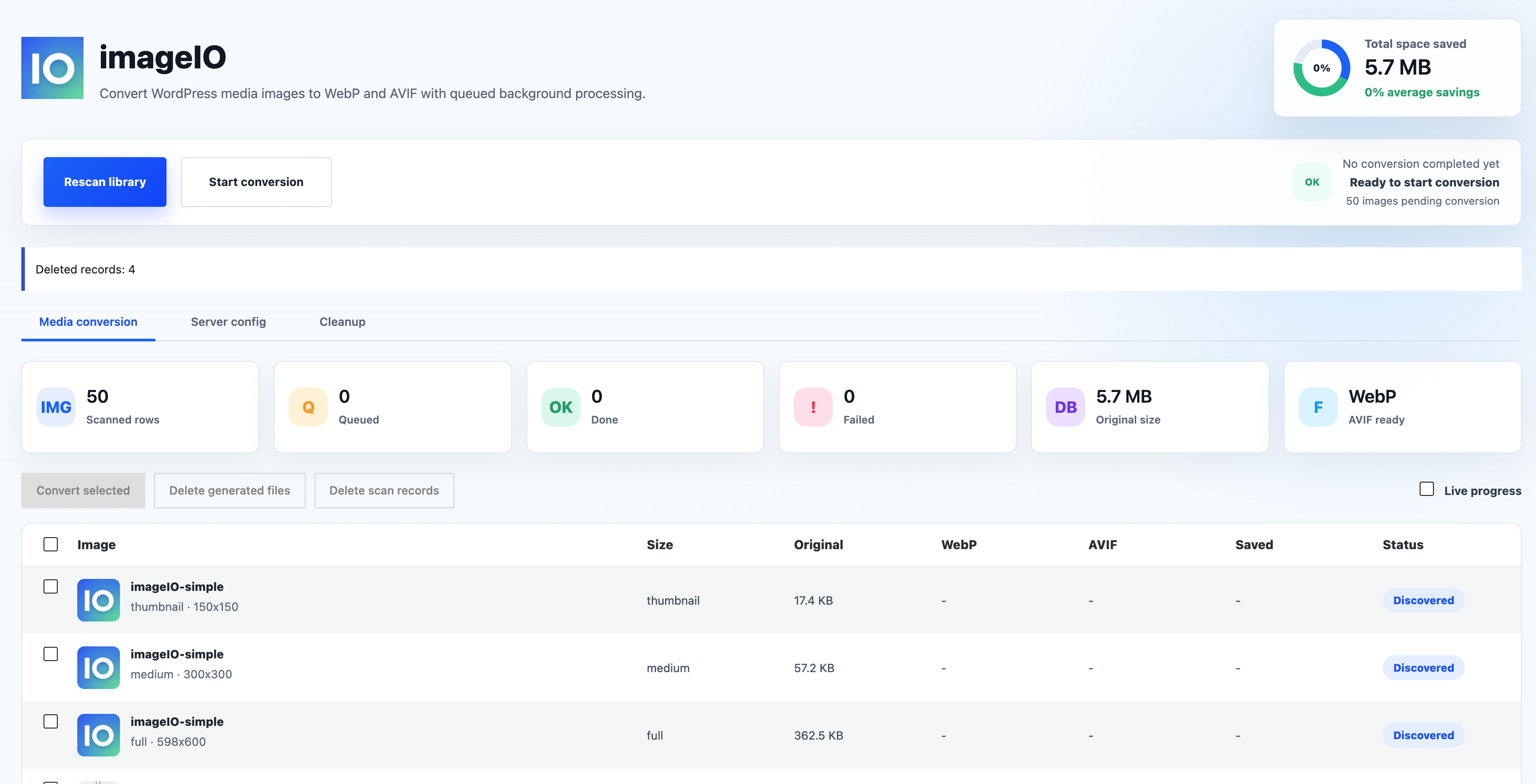
ImageIO scans existing attachment records, groups image sizes, and gives operators a clear conversion queue before touching generated files.
- JPG/PNG detection
- Image size grouping
- Rescan and cleanup controls
Next-gen image conversion and object-storage delivery for WordPress.
Focused plugin capabilities for WordPress sites that need lighter frontend delivery and simpler operations.
ImageIO scans existing attachment records, groups image sizes, and gives operators a clear conversion queue before touching generated files.
The free edition focuses on practical next-gen formats for WordPress media libraries, with server delivery rules that keep the frontend lighter.
The Pro roadmap extends conversion into FTP, OSS, incremental conversion, lazy loading, and API workflows for larger operational sites.
Most image optimization plugins are built around external compression services, recurring credit limits, or frontend scripts. ImageIO focuses on local format conversion and clean WordPress delivery.
ImageIO keeps conversion local, avoids usage-based billing, and offers lifetime access at roughly 5%-10% of the long-term cost of many recurring optimizer subscriptions.
Convert JPG and PNG media to WebP/AVIF, serve lighter browser-ready assets automatically, and extend the pipeline with FTP, OSS, lazy loading, and API workflows.
Convert Media Library JPG/PNG files to WebP and AVIF
Server-level delivery of lighter browser-supported variants
Bulk conversion for existing WordPress media libraries
FTP storage and object storage integrations
Automatic incremental conversion for newly uploaded images
API calls for headless and automation workflows
OSS lazy load support with stable front-end rendering
Guides, release notes, and operational notes tagged for KuDesign ImageIO.
Lazy loading is built into WordPress core and every modern browser — but applied wrong, it actively damages LCP scores. This guide covers how native loading='lazy' and fetchpriority='high' work together, where plugins still add value (CSS backgrounds, iframes, object storage), and how to diagnose lazy loading misconfiguration.
PerformanceWhen your WordPress media library outgrows your web server, object storage (S3, OSS, R2) is the practical next step. This guide covers what object storage is, when it makes sense, how to set it up with the right plugin, and how to combine it with WebP/AVIF conversion for a complete image delivery stack.
PerformanceImage optimization affects SEO through two distinct channels: direct image indexing signals (alt text, structured data, filenames) and indirect page performance signals (LCP, Core Web Vitals). This guide covers what Google actually measures, where WebP and AVIF fit in, and a prioritized checklist for WordPress site owners.
PerformanceSmush, ShortPixel, and Imagify are the dominant WordPress image optimization plugins — but they all send your images to external servers for processing. This comparison covers what each plugin actually does, how costs scale with image volume, and where KuDesign ImageIO's local conversion approach fits in.
PerformanceImages are the LCP element on 72% of mobile pages. This article explains precisely how WebP and AVIF format conversion affects Largest Contentful Paint, CLS, and INP — with real download-time benchmarks, PageSpeed audit fixes, and a practical guide to deploying the improvement on WordPress without touching your theme.
PerformanceThere are two ways to serve WebP and AVIF to the right browsers: client-side with the picture element, or server-side via HTTP Accept header negotiation. This article explains how server-side negotiation works at a technical level — Apache and Nginx configuration included — and why it's the more practical approach for WordPress sites with existing content.